
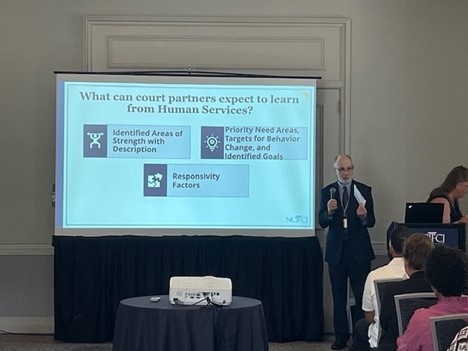
The Children’s Court Improvement Program (CCIP) and the Department of Children and Families (DCF) were selected to present at the 88th Annual National Council of Juvenile and Family Court Judges (NCJFCJ) conference in Chicago on the Tailored Dispositional Orders Project: Promoting Positive Change Through Shared Responsibility.
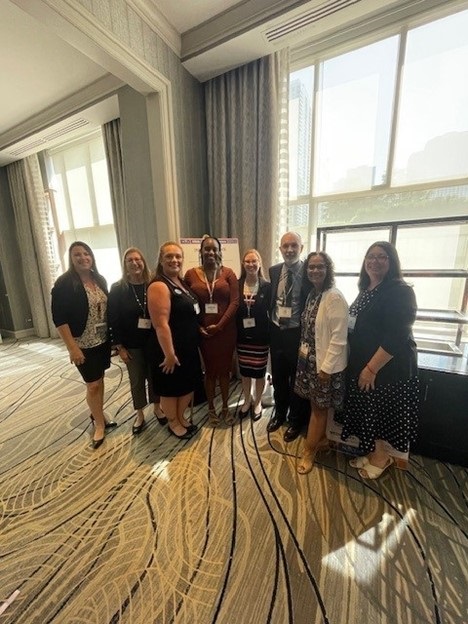
Judge Todd Ziegler, Monroe County, Kristen Wetzel, CCIP, and Moe Green and Jenna Dunlap, DCF, co-presented together to share information about Wisconsin’s Tailored Dispositional Orders Project with other jurisdictions. The workshop session was featured under the Juvenile Justice track and was very well-attended! Several states were excited to learn about the successful and innovative project, implementation tips, and feedback from judicial officers in order to implement a similar project in their jurisdiction.
CCIP also sponsored three judges from the Wisconsin Judicial Committee on Child Welfare to attend the NCJFCJ annual conference - Judge Ramona Gonzalez, La Crosse County, Retired Judge Marshall Murray, Milwaukee County, and Judge Angela Sutkiewicz, Sheboygan County.
CCIP and DCF have provided the CHIPS Tailored Dispositional Orders training to 41 counties and one tribe so far, with seven additional counties scheduled this year. Additionally, CCIP and DCF have provided the Youth Justice Tailored Dispositional Orders training to 31 counties, with five additional counties scheduled later this year. Both trainings focus on individualizing the conditions ordered by the court. As explained by one of the attendees, “The speakers reminded us that this is a complex system and that one size does not fit all.”
Wisconsin is embarking on the evaluation phase of the project after counties have implemented their updated conditions. CHIPS cases will be reviewed before and after implementation to examine the number of conditions, permanency outcomes (including time to reunification, guardianship, and termination of parental rights), reading level of conditions, if the conditions are behavior-based, and whether the parents’ conditions are different from one another. Youth Justice cases will be reviewed for the number of conditions, length of time on supervision, reading level of conditions, frequency of sanctions, detentions, and/or 72-hour holds, and frequency of cases where the District Attorney’s office overrides the intake worker’s recommendation not to file a petition.
CCIP and DCF are continuing to expand the Tailored Dispositional Orders Project statewide. If any counties or tribes are interested in learning more about the project, please get in touch with Kristen.Wetzel@wicourts.gov.
Third Branch eNews is an online monthly newsletter of the Director of State Courts Office. If you are interested in contributing an article about your department’s programs or accomplishments, contact your department head. Information about judicial retirements and judicial obituaries may be submitted to: Sara.Foster@wicourts.gov