

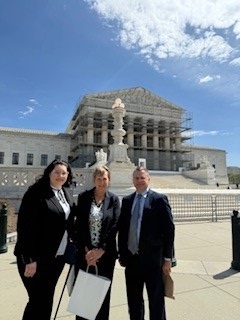
At 9:00 a.m. on March 31, 2025, Judges Kelly Thimm (Circuit Court, Superior) and Lisa Stark (District III Court of Appeals), and Judge Stark’s long‑term clerk, Nicole Murphy, stood in line on the second floor of the United States Supreme Court building eagerly awaiting admission to hear oral argument in the case of Catholic Charities Bureau, Inc. v. Wisconsin Labor and Industry Review Commission. The hallway was filled with information highlighting the Court’s history, and we were surrounded by fellow members of the Supreme Court Bar and others interested in this important case.
Our journey to this moment began years earlier. In October 2020, Judge Thimm issued an order reversing the Commission’s determination that four of Catholic Charities’ nonprofit sub‑entities were not “operated primarily for religious purposes” and were therefore not exempt from Wisconsin’s Unemployment Compensation Act under the religious purposes exemption, Wis. Stat. § 108.02(15)(h)2. Judge Thimm concluded that the organizations were operated primarily for religious purposes and therefore not subject to pay unemployment insurance.
On appeal, the District III Court of Appeals held oral argument and issued a published opinion reversing Judge Thimm. The Court concluded that in determining whether an organization qualifies for the religious purposes exemption, the Commission must consider both the nonprofit organization’s motives and its activities. Based on the appellate briefing, the Court further determined that the First Amendment was not implicated in the case. Applying the above standard, the Court concluded that the Commission correctly determined that the Catholic Charities’ sub-entities were not organizations operated primarily for religious purposes and, therefore, were not exempt from unemployment taxation.
The Wisconsin Supreme Court affirmed the Court of Appeals. As summarized later by the United States Supreme Court, “the Wisconsin Supreme Court denied the exemption, holding that petitioners were not ‘operated primarily for religious purposes’ because they neither engaged in proselytization nor limited their charitable services to Catholics.” As a result, the United States Supreme Court accepted Catholic Charities’ Petition for Review on the limited issue of whether “a state violate[s] the First Amendment’s Religion Clauses by denying a religious organization an otherwise-available tax exemption because the organization does not meet the state’s criteria for religious behavior?”
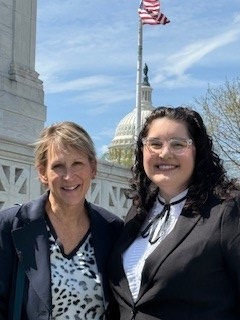
Understanding the significance of the moment, Judges Thimm, Stark, and Ms. Murphy decided to travel to Washington, D.C., to attend the oral argument. To increase our chances of admission to the oral argument, we all applied for and were admitted to the United States Supreme Court Bar Association. While bar admission does not guarantee courtroom access, it significantly improves the odds.
We arrived in Washington, D.C., at the peak of cherry blossom season, and we enjoyed sightseeing for a few days—including a hockey game for Judge Thimm—before argument day. On the day of the arguments, we arrived early and were dismayed to find that the exterior of the building was undergoing renovation. We were eventually ushered through a side door of the building and led to the waiting hall. There were many bar members and visitors in attendance that day. As a result, Judge Thimm’s family, who had accompanied him on the trip, were not admitted—only nine public members (who stood in line for hours) were granted admission.
After passing through security and storing all personal items except a pen and notepad, we were escorted to the courtroom on the third floor. The courtroom is striking, with a wealth of rich, dark wood and marble steeped in history. It held several hundred people, with us seated in the middle of the room. No pictures were permitted inside.
Chief Justice Roberts opened the session by welcoming attendees and admitting new members to the Supreme Court Bar. The Court then proceeded with oral argument, which lasted over ninety minutes. Every justice participated actively by posing questions.
Although it was thrilling to be in the room, Judge Stark and Ms. Murphy found it frustrating that the issue had evolved so much from how it was argued and decided in the Court of Appeals. Still, such shifts are common as a case moves through the appellate process. Given the tenor of the Justices’ questions, it seemed likely that a reversal was coming, which indeed occurred.
Thanks to our bar memberships, our group was later allowed access “for research” to the Supreme Court Library. Reached by a charming vintage elevator operated by a gloved attendant, the library is an awe‑inspiring space filled with dark wood, many carrels, vast resources, and the quiet hum of scholarship. Standing there, it was easy to feel the presence of the many learned justices and their staff who had worked in this very location over many years.
Before leaving, we visited the Supreme Court gift shop and paused to take a few photos (where permitted), including a group shot in front of the iconic building (scaffolding and all).
For any legal profession or appellate enthusiast, attending a Supreme Court oral argument is an unforgettable experience. Congratulations to those who have had the opportunity to argue a case before the Supreme Court. For those of you who have not attended a Supreme Court oral argument, we encourage you to seek bar admission, which is a straightforward process, and attend an argument any time you are in Washington, D.C. Witnessing the highest Court in the land at work is a powerful reminder of the importance and impact of our justice system.
Third Branch eNews is an online monthly newsletter of the Director of State Courts Office. If you are interested in contributing an article about your department’s programs or accomplishments, contact your department head. Information about judicial retirements and judicial obituaries may be submitted to: Sara.Foster@wicourts.gov