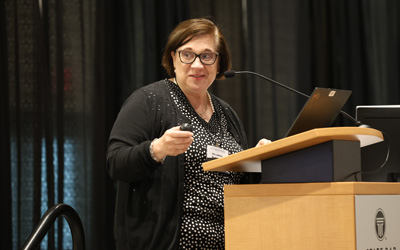
Director of State Courts Audrey K. Skwierawski highlighted ongoing work to improve access, transparency, technology, and fairness across the Wisconsin Court System during remarks to members of the State Bar of Wisconsin.
The presentation focused on the Court System’s shared mission: protecting rights and liberties, supporting the rule of law, and providing a forum for resolving disputes that is fair, accessible, independent, and effective.
Director Skwierawski said that the mission depends on a persistent partnership between the courts, lawyers, counties, policymakers, and justice system stakeholders.
“Our mission is simple to say and hard to do well: protect rights, maintain the rule of law, and provide a forum that is fair, accessible, independent, and effective,” Director Skwierawski said. “That work requires more than courts alone. It requires the partnership of lawyers, counties, policymakers, court staff, and the public. My message is that we are listening, we are improving, and we are committed to doing this work together.”
Director Skwierawski also highlighted several ongoing initiatives aimed at improving court operations and public access, including:
- Artificial intelligence: The Court System’s AI Committee is developing sample policies for court personnel, judges, and litigants.
- Attorney recruitment and retention: Work continues on efforts to keep more law school graduates in Wisconsin, attract lawyers from other states, address rural legal deserts, and support prosecutors and public defenders.
- Access and transparency: The Court System is examining Zoom data, county technology needs, training opportunities, Supreme Court coverage, and improvements to public access tools, including the redesigned Supreme Court and Court of Appeals public search site.
- Interpreter services: Court System staff are working with judges, counties, interpreters, and clerks of circuit court to better understand barriers to service, rising expenses, and needs that vary across the state.
- Digital Audio Recording: A workgroup is reviewing issues related to cost, availability, redaction, open records, and courtroom operation, with a rule petition anticipated in the future.
- Mental health: The Director’s Office is supporting Sequential Intercept Model mapping to help courts and community partners identify gaps and improve responses for people with mental health and substance use issues.
- Court user feedback: Pilot projects in La Crosse and Monroe counties are using surveys and outreach to better understand how people experience the courts and where improvements can be made.
Director Skwierawski closed by thanking State Bar leaders and members for their work and emphasized the importance of continued collaboration across the legal profession.
“We are here to partner with you in working toward that shared mission,” Director Skwierawski said.
Third Branch eNews is an online monthly newsletter of the Director of State Courts Office. If you are interested in contributing an article about your department’s programs or accomplishments, contact your department head. Information about judicial retirements and judicial obituaries may be submitted to: Sara.Foster@wicourts.gov