

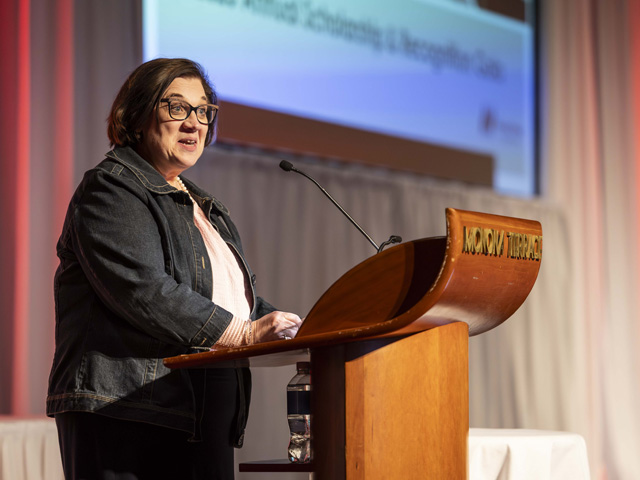


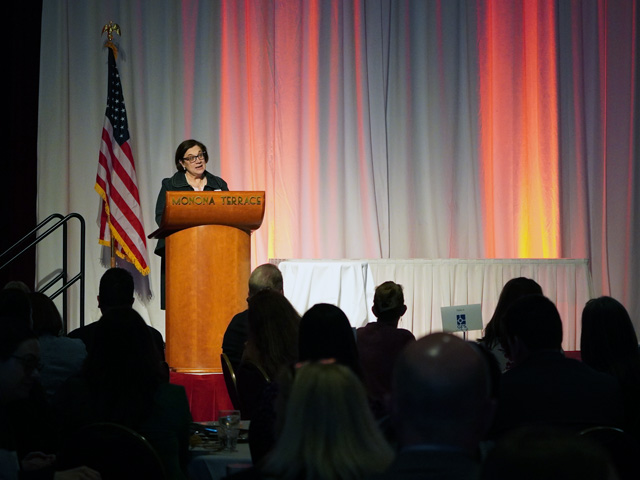
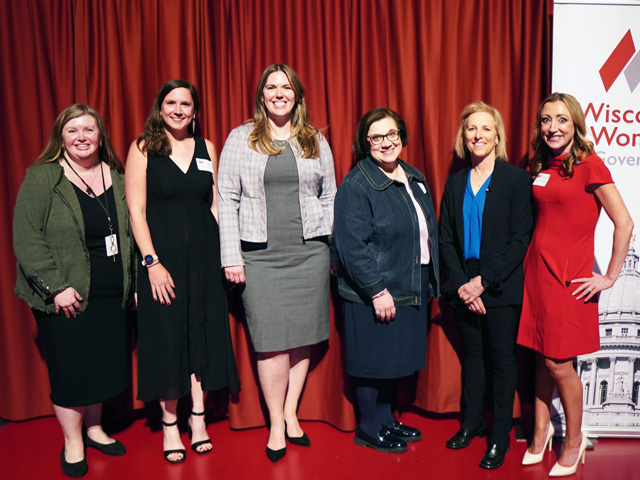
Chief Justice Jill Karofsky delivered the keynote address at Wisconsin Women in Government’s 2026 Annual Scholarship & Recognition Gala, speaking about women in public service, judicial independence, and the role of the courts in protecting democracy.
The gala was held on April 29 at Monona Terrace in Madison. The annual event brings together professionals and public servants from across Wisconsin for an evening focused on leadership, service, and fellowship in government. The program also included scholarship and award recognition, a leadership panel, and a silent auction supporting WWIG programs and scholarships.
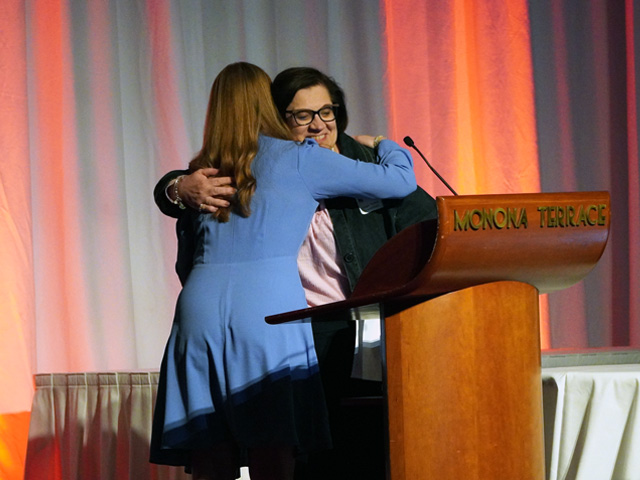
Director of State Courts Audrey Skwierawski introduced Chief Justice Karofsky, recalling their shared history at the Wisconsin Department of Justice, where both served as the Violence Against Women Resource Prosecutor. Director Skwierawski described Chief Justice Karofsky as a mentor and colleague whose work has long reflected a commitment to improving the justice system, upholding the rule of law, and strengthening democracy.
In her keynote, Chief Justice Karofsky reflected on the artwork displayed in the Wisconsin Supreme Court hearing room, including four large paintings that depict Roman law, the Magna Carta, the signing of the U.S. Constitution, and a territorial-era Wisconsin trial. She noted that the paintings include more than 80 men and no women, and contrasted that absence with the current Wisconsin Supreme Court, where six of the seven justices are women.
Chief Justice Karofsky also spoke about threats to judges, court staff, attorneys, jurors, witnesses, victims, and others who come to courthouses. She said public confidence in the judiciary depends on courts being able to decide cases according to the law, without intimidation, political pressure, or violence.
She emphasized that disagreement with court decisions is part of a healthy democracy, but personal attacks on judges and efforts to undermine court decisions damage public trust in the judicial system. Chief Justice Karofsky said judges across Wisconsin continue to do difficult work with steadiness and resolve in municipal courts, circuit courts, the Court of Appeals, and the Supreme Court.
“Judicial independence is vital to protecting our democracy, and it survives only when the law, not politics or violence, guides our courts. And preserving that independence requires people, both inside and outside the courtroom, who are willing to defend that principle,” Chief Justice Karofsky said.
Chief Justice Karofsky closed by returning to the theme of women’s long struggle for equal participation in public life, describing the Portrait Monument in the U.S. Capitol Rotunda honoring Elizabeth Cady Stanton, Lucretia Mott, and Susan B. Anthony. The monument was dedicated in 1921, moved out of the Rotunda the next day, and returned 77 years later.
The remarks connected Wisconsin Women in Government’s focus on women in government with broader themes of mentorship, public service, judicial independence, and the rule of law.
Third Branch eNews is an online monthly newsletter of the Director of State Courts Office. If you are interested in contributing an article about your department’s programs or accomplishments, contact your department head. Information about judicial retirements and judicial obituaries may be submitted to: Sara.Foster@wicourts.gov