
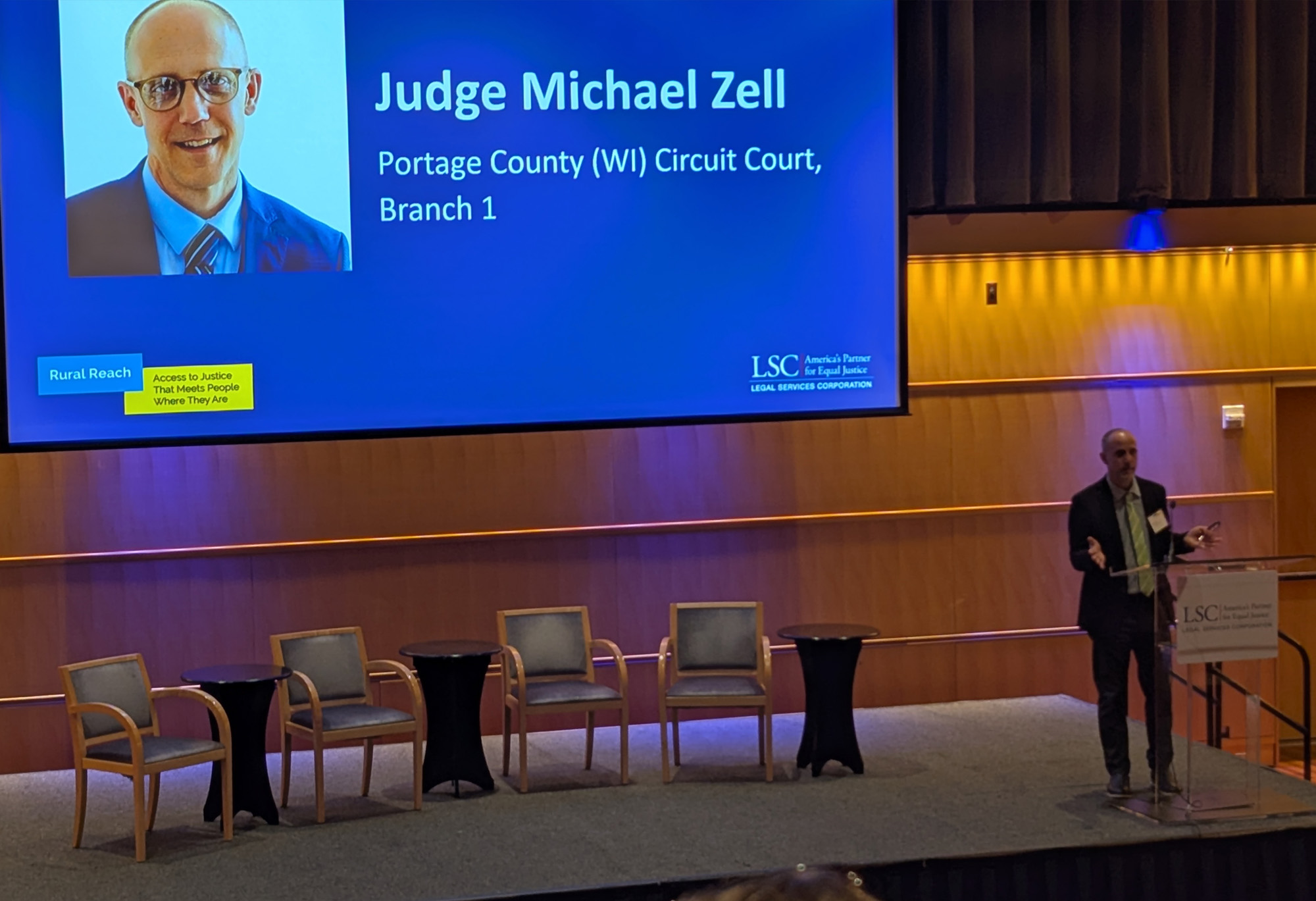
Wisconsin Supreme Court Justice Rebecca Frank Dallet and Portage County Circuit Court Judge Michael Zell were featured speakers at the Legal Services Corporation’s Rural Reach symposium held October 29 in Madison. The program focused on improving civil legal access in rural communities and highlighted strategies to strengthen attorney recruitment, support self-represented litigants, and encourage collaboration across the justice system.
The event brought together judges, attorneys, advocates, and policymakers from across the country to discuss the widening gap between where lawyers live and where legal help is most needed. Justice Dallet noted that Wisconsin, like many states, faces significant challenges in ensuring equitable access to legal representation in rural areas. She pointed out that three out of four Wisconsin attorneys live in just three of the most populated counties of Dane, Milwaukee, and Waukesha; leaving large portions of the state without adequate legal coverage.
Justice Dallet opened her remarks by recognizing the Ho-Chunk Nation and Wisconsin’s eleven other First Nations and emphasized the importance of cooperation between state and tribal justice systems. She said that ensuring fairness and accessibility for all communities is a shared responsibility among courts.
“The LSC’s Report from the Rural Justice Task Force indicates that more than 77 percent of low-income rural households experienced at least one civil legal problem last year and that these households did not receive any or enough legal help 94 percent of the time,” Justice Dallet said. She explained that the shortage of attorneys in rural areas has real consequences for families, veterans, and victims of domestic abuse. “The ripple effects of these losses impact the entire community,” she added.
Justice Dallet described her experience as a circuit court judge in Milwaukee County, recalling an eviction trial in which an unrepresented tenant struggled to present evidence. “It was difficult to watch someone with no legal training try to navigate a system not designed for unrepresented litigants,” she said. “At the end of the trial, he had not only lost his home but also his confidence that the courts were a place where you can obtain justice.”
Justice Dallet also outlined statewide efforts to expand civil legal aid and attract attorneys to underserved areas. She highlighted the State Bar’s Rural Clerkship Program and its partnership with the Wisconsin Law Foundation, which offers stipends to encourage rural practice. She noted Supreme Court initiatives expanding pro bono participation—allowing inactive and emeritus attorneys to volunteer and granting continuing legal education credit for pro bono service. Dallet also referenced the work of the Attorney Retention and Recruitment Committee and the Wisconsin Access to Justice Commission, which continues to map legal service deserts, analyze case trends, and manage the Wisconsin Free Legal Answers website.
Judge Zell contributed a perspective from a rural circuit court, discussing how attorney shortages affect case scheduling, public defender appointments, and family law proceedings. He described how long travel distances, limited staff, and the scarcity of available attorneys can delay hearings and outcomes in both civil and criminal cases. He also spoke about partnerships between county agencies, law enforcement, and courts that help improve coordination and ensure access to services across rural areas.
Justice Dallet closed her remarks by underscoring the shared responsibility to improve access through collaboration. “When people have meaningful access to legal help, our entire justice system works better,” she said. “Cases move more efficiently, decisions are better informed, and outcomes are fairer.”
The symposium took place at the Overture Center for the Arts in Madison, with support from Ascendium Education Group, Quarles & Brady, and Frontline Justice. It coincided with the release of the Legal Services Corporation’s Report from the Rural Justice Task Force, available here.
Wisconsin’s participation in the program provided an opportunity to share local experiences, learn from national perspectives, and exchange ideas on how courts and communities can continue to address rural access to justice.
Third Branch eNews is an online monthly newsletter of the Director of State Courts Office. If you are interested in contributing an article about your department’s programs or accomplishments, contact your department head. Information about judicial retirements and judicial obituaries may be submitted to: Sara.Foster@wicourts.gov