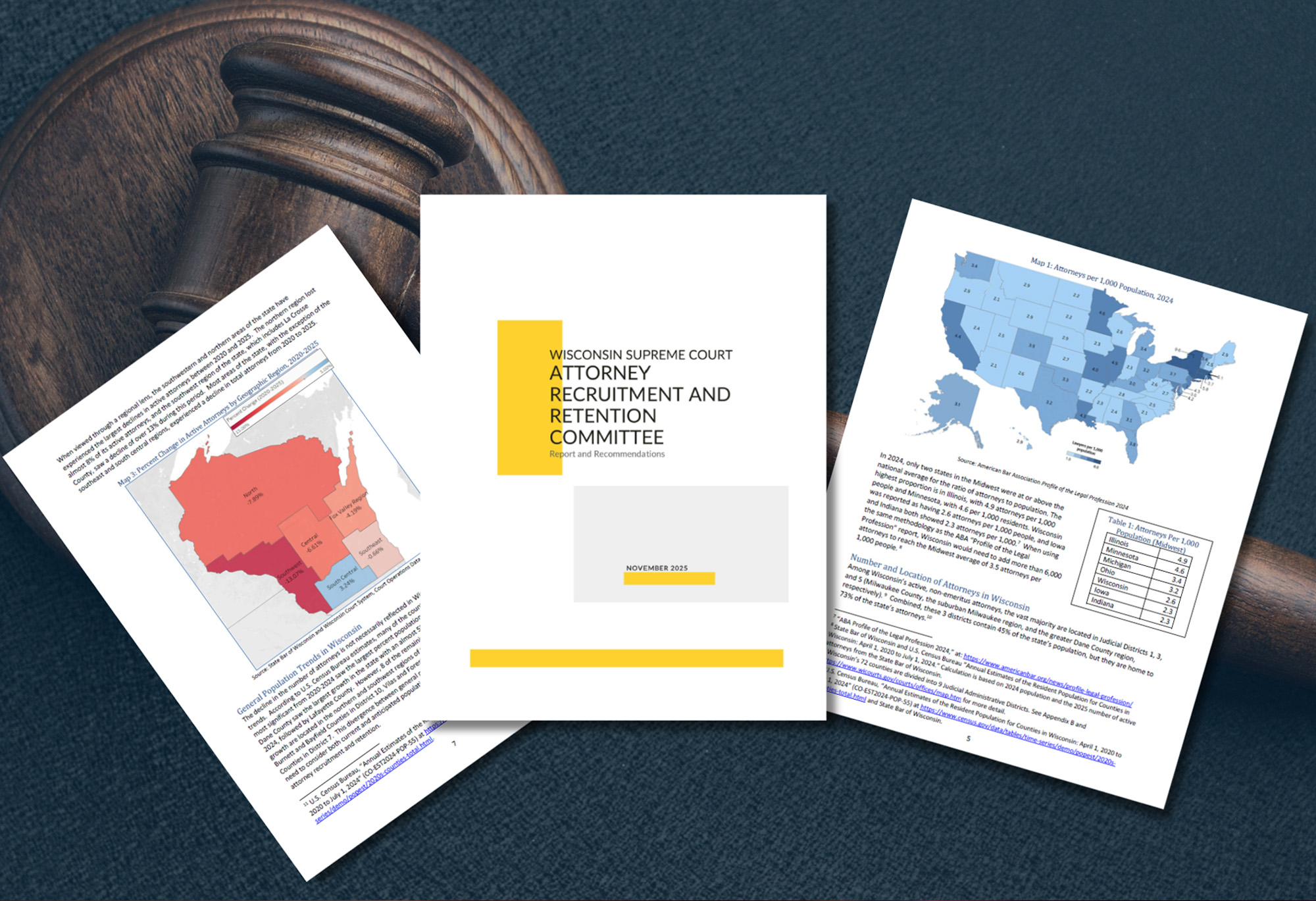
The Wisconsin Supreme Court’s Attorney Recruitment and Retention Committee has released its final report summarizing current attorney workforce trends and outlining several areas for continued study. The Supreme Court created the committee in June 2024 to examine statewide attorney shortages and consider ways to support recruitment and retention in both rural and high-need regions.
Former Chief Justice Annette Kingsland Ziegler chaired the committee during its initial phase, followed by former Chief Justice Ann Walsh Bradley. Justice Brian Hagedorn most recently served as chair as the committee completed its work.
“This report helps illustrate the real challenges created by attorney shortages in many parts of the state,” said Chief Justice Jill Karofsky. “These shortages affect the people who rely on our courts and the communities we serve. The Court remains committed to understanding this issue and supporting efforts that strengthen access to justice across Wisconsin. I want to thank Justice Annette Kingsland Ziegler and the members of the committee for their thoughtful work and for laying the foundation for continued discussion.”
The report notes that the number of active attorneys in Wisconsin has declined slightly since 2020, with the largest decreases occurring in northern, central, and southwestern parts of the state. These regions also include many of the counties with the highest recent population growth, which has widened the gap between community needs and available legal services.
The committee met seven times between September 2024 and September 2025. Two workgroups also contributed research on financial incentive programs and limited license practitioner models. Membership included judges, district court administrators, law school leaders, prosecutors, defense attorneys, Access to Justice Commission representatives, and attorneys appointed by the State Bar of Wisconsin.
Key findings
According to the analysis in the report, seventy-three percent of Wisconsin’s active attorneys are located in Judicial Districts 1, 3, and 5, which together account for less than half of the state’s population. Several counties in northern and southwestern Wisconsin have experienced attorney declines of eight to thirteen percent since 2020.
Circuit court data shows that the number of attorneys appearing in cases of any type has decreased by nearly ten percent since 2017. During the same period, felony dispositions increased by about fourteen percent, resulting in higher workloads for both defense attorneys and prosecutors.
At the same time, State Bar admissions have increased in recent years but have not kept pace with retirements or attorneys leaving the profession, particularly in regions outside the metropolitan areas.
Recommendations
The report identifies four areas the committee suggests for continued evaluation:
- Financial incentive programs. The report outlines examples from other states that have used financial incentive models to encourage attorneys to live and work in rural areas. The committee recommends assessing whether a similar approach could complement the State Bar’s current rural practice initiatives.
- Expanding attorney pathways. This includes further review of the Uniform Bar Exam and exploration of additional legal education models that could broaden access for students living in rural and northern regions.
- Limited license practitioner programs. Several states have adopted or tested programs that allow trained non-attorney professionals to assist with specific civil and family law matters. The committee recommends study of whether a similar program could increase service capacity in Wisconsin.
- Use of remote technology. The report encourages continued support for remote appearances in routine, non-evidentiary hearings, noting that broader use of this technology may help attorneys take cases in counties outside their home region.
Next steps
The committee recommends reconvening in twelve months to review activity in each area and identify whether additional strategies are needed. The full Attorney Recruitment and Retention Committee Report is available here.